
 Image 1 of 5
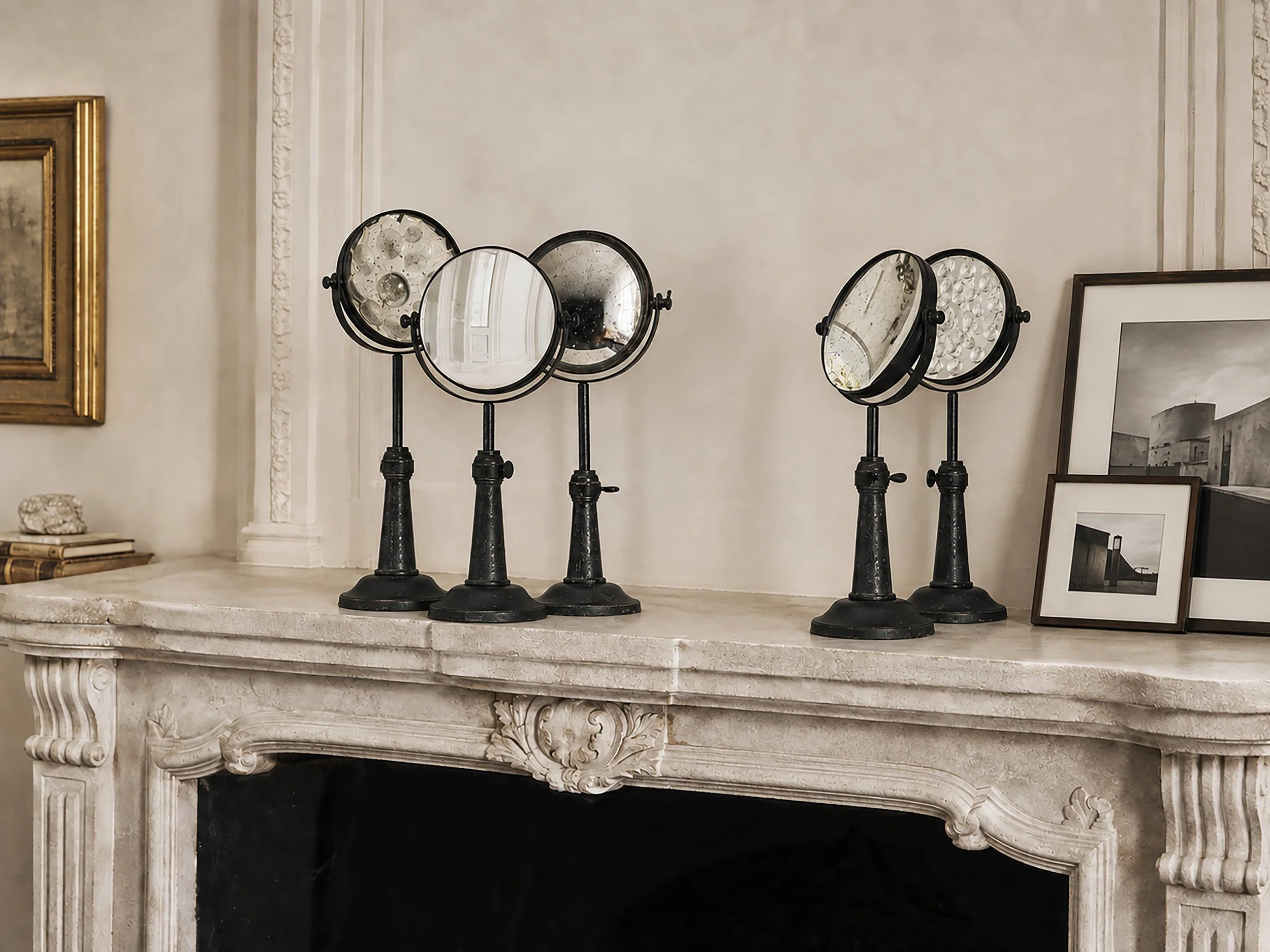 Image 2 of 5
 Image 3 of 5
 Image 4 of 5
 Image 5 of 5
Florence, Italy — circa 1920s
This unusual group consists of four early twentieth-century ophthalmic mirrors accompanied by a table-mounted magnifying glass, all originating from a Florentine ophthalmic studio.
The instruments are mounted on adjustable cast-iron stands finished in black enamel. Designed originally for medical examination and optical work, the mirrors could be positioned at various heights and angles to direct light precisely during diagnostic procedures.
The restrained industrial design of the stands, combined with the reflective surfaces of the mirrors and magnifying glass, gives the ensemble a sculptural and intriguing character. Removed from their original clinical context, the instruments now function as a fascinating cabinet of curiosities that reflects the aesthetics of early twentieth-century scientific equipment.
The group can be displayed together as a decorative installation or arranged individually across a desk, console, or shelving system.
The instruments remain in good vintage condition with minor wear consistent with their age and original use.
The set works particularly well in studies, libraries, boutique hospitality environments, or curated interiors where historic scientific instruments contribute to the atmosphere of the space.
Florence, Italy — circa 1920s
This unusual group consists of four early twentieth-century ophthalmic mirrors accompanied by a table-mounted magnifying glass, all originating from a Florentine ophthalmic studio.
The instruments are mounted on adjustable cast-iron stands finished in black enamel. Designed originally for medical examination and optical work, the mirrors could be positioned at various heights and angles to direct light precisely during diagnostic procedures.
The restrained industrial design of the stands, combined with the reflective surfaces of the mirrors and magnifying glass, gives the ensemble a sculptural and intriguing character. Removed from their original clinical context, the instruments now function as a fascinating cabinet of curiosities that reflects the aesthetics of early twentieth-century scientific equipment.
The group can be displayed together as a decorative installation or arranged individually across a desk, console, or shelving system.
The instruments remain in good vintage condition with minor wear consistent with their age and original use.
The set works particularly well in studies, libraries, boutique hospitality environments, or curated interiors where historic scientific instruments contribute to the atmosphere of the space.