Jaipur, Rajasthan (India), circa 1880
This rare ceremonial sedan chair from Rajasthan dates to the late nineteenth century and was traditionally used during royal wedding processions by the court of Jaipur. Such elaborately crafted sedan chairs were employed to carry members of royal families during important ceremonial events, reflecting both status and the highly developed decorative traditions of Rajput court culture.
Constructed in walnut and distinguished by its architectural proportions, the chair exemplifies the refined craftsmanship associated with royal commissions in northern India during the late nineteenth century. Objects of this type were not intended for everyday domestic use but rather served as ceremonial conveyances within elaborate wedding processions and court festivities.
The piece has been thoughtfully reinterpreted by the artists of KalaRara Roma, who have introduced subtle contemporary interventions while preserving the historic structure of the object. These additions include silver gilding applied to the side-panel grillwork, hand-embroidered linen seat cushions, hand-painted seat backs, and a hand-hammered oxidized lead panel integrated into the footrest and embellished with Venetian glass crystals. The result is a singular work that bridges historical artifact and sculptural functional art.
Originally owned by the Maharaja of Jaipur, this remarkable object represents both a fragment of royal Indian court culture and a unique collectible statement piece suited to contemporary interiors.
Condition
The historic structure of the sedan chair remains intact and stable. KalaRara Roma has introduced artistic enhancements while preserving the original architectural form of the object.
Ideal Placement
Because of its ceremonial scale and vertical presence, the piece functions particularly well as a dramatic focal point in entry halls, gallery-like interiors, or hospitality spaces where its sculptural character can be fully appreciated.
Dimensions
Length: 163 cm
Width: 53 cm
Height: 170 cm
Jaipur, Rajasthan (India), circa 1880
This rare ceremonial sedan chair from Rajasthan dates to the late nineteenth century and was traditionally used during royal wedding processions by the court of Jaipur. Such elaborately crafted sedan chairs were employed to carry members of royal families during important ceremonial events, reflecting both status and the highly developed decorative traditions of Rajput court culture.
Constructed in walnut and distinguished by its architectural proportions, the chair exemplifies the refined craftsmanship associated with royal commissions in northern India during the late nineteenth century. Objects of this type were not intended for everyday domestic use but rather served as ceremonial conveyances within elaborate wedding processions and court festivities.
The piece has been thoughtfully reinterpreted by the artists of KalaRara Roma, who have introduced subtle contemporary interventions while preserving the historic structure of the object. These additions include silver gilding applied to the side-panel grillwork, hand-embroidered linen seat cushions, hand-painted seat backs, and a hand-hammered oxidized lead panel integrated into the footrest and embellished with Venetian glass crystals. The result is a singular work that bridges historical artifact and sculptural functional art.
Originally owned by the Maharaja of Jaipur, this remarkable object represents both a fragment of royal Indian court culture and a unique collectible statement piece suited to contemporary interiors.
Condition
The historic structure of the sedan chair remains intact and stable. KalaRara Roma has introduced artistic enhancements while preserving the original architectural form of the object.
Ideal Placement
Because of its ceremonial scale and vertical presence, the piece functions particularly well as a dramatic focal point in entry halls, gallery-like interiors, or hospitality spaces where its sculptural character can be fully appreciated.
Dimensions
Length: 163 cm
Width: 53 cm
Height: 170 cm

 Image 1 of 7
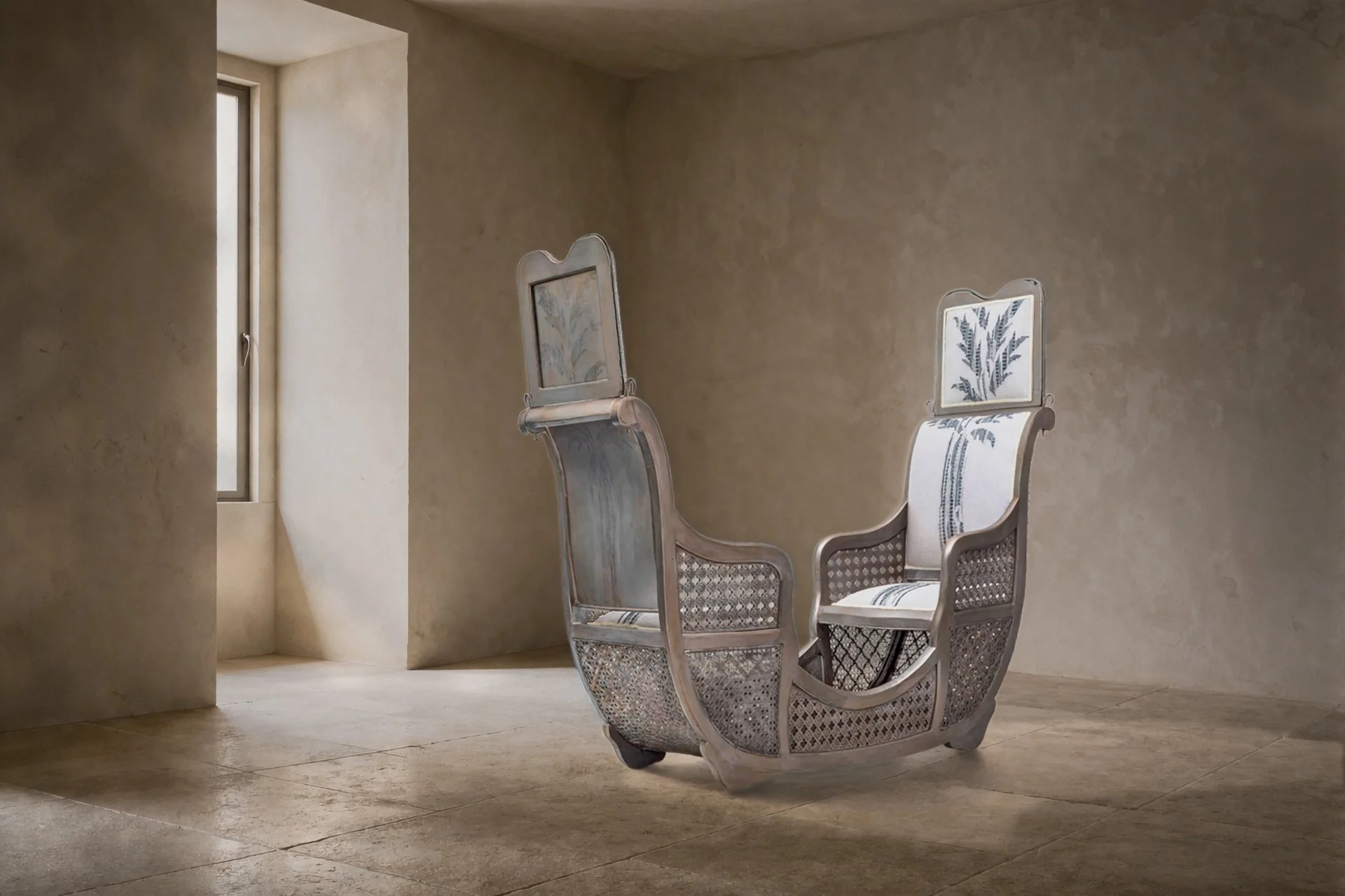 Image 2 of 7
 Image 3 of 7
 Image 4 of 7
 Image 5 of 7
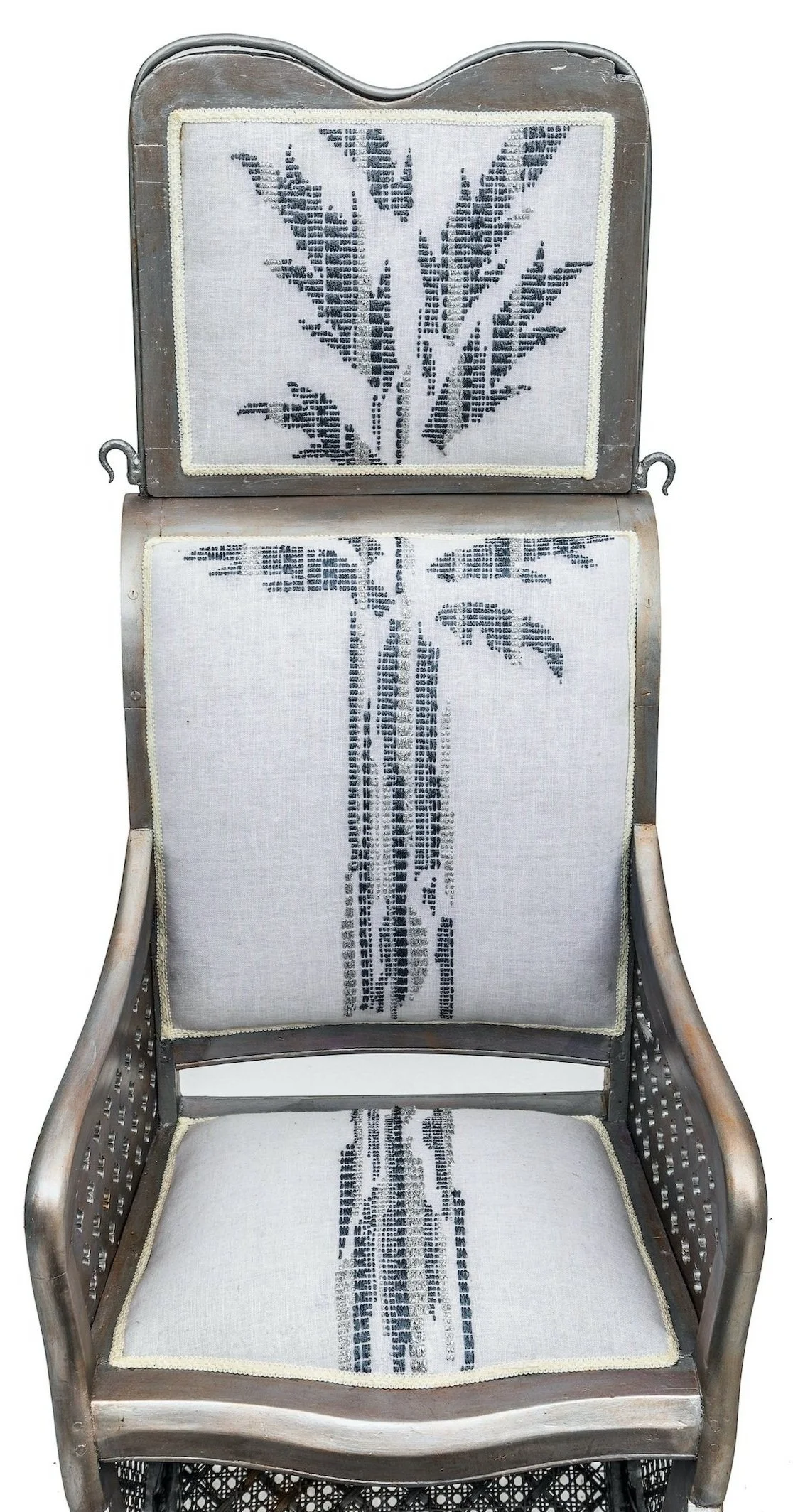 Image 6 of 7
 Image 7 of 7