Rajasthan, India — Late 19th Century
This remarkable late nineteenth-century campaign picnic table represents a rare example of portable furniture produced for British colonial officers stationed in India during the period of the British Raj. Designed with exceptional ingenuity, the entire ensemble—including four chairs—folds into a compact traveling case, reflecting the practical requirements of military and colonial life in the subcontinent.
Crafted by hand in mahogany, the table incorporates four attached chairs with carved spindle backs and woven rattan seats. Each chair folds neatly into the underside of the table, while the table itself collapses and secures with a brass latch. Once closed, the piece transforms into a suitcase-like form with brass carrying handles, allowing it to be transported easily for outdoor dining or travel.
Campaign furniture of this type was often custom made for officers serving in colonial administrations, and examples that survive intact with their original folding mechanisms are increasingly rare.
The structure of the table and chairs remains entirely original and has not required restoration. The tabletop has, however, been reinterpreted by the artists of KalaRara Roma with a hand-painted black-and-white optical pattern depicting two intertwined zebras. This contemporary intervention introduces an unexpected graphic layer to the historic object, creating a dialogue between nineteenth-century craftsmanship and modern artistic expression.
Condition
The original mahogany structure and folding mechanisms remain intact and functional. The chairs retain their carved spindle backs and woven rattan seats. The tabletop has been hand painted with an op-art inspired zebra motif.
Ideal Placement
Because of its scale and mechanical ingenuity, the piece functions beautifully as a conversation piece within eclectic interiors, gallery-like spaces, or hospitality settings where unusual historical objects can serve as focal points.
Dimensions (Open)
Length: 220 cm
Width: 106 cm
Height: 78 cm
Rajasthan, India — Late 19th Century
This remarkable late nineteenth-century campaign picnic table represents a rare example of portable furniture produced for British colonial officers stationed in India during the period of the British Raj. Designed with exceptional ingenuity, the entire ensemble—including four chairs—folds into a compact traveling case, reflecting the practical requirements of military and colonial life in the subcontinent.
Crafted by hand in mahogany, the table incorporates four attached chairs with carved spindle backs and woven rattan seats. Each chair folds neatly into the underside of the table, while the table itself collapses and secures with a brass latch. Once closed, the piece transforms into a suitcase-like form with brass carrying handles, allowing it to be transported easily for outdoor dining or travel.
Campaign furniture of this type was often custom made for officers serving in colonial administrations, and examples that survive intact with their original folding mechanisms are increasingly rare.
The structure of the table and chairs remains entirely original and has not required restoration. The tabletop has, however, been reinterpreted by the artists of KalaRara Roma with a hand-painted black-and-white optical pattern depicting two intertwined zebras. This contemporary intervention introduces an unexpected graphic layer to the historic object, creating a dialogue between nineteenth-century craftsmanship and modern artistic expression.
Condition
The original mahogany structure and folding mechanisms remain intact and functional. The chairs retain their carved spindle backs and woven rattan seats. The tabletop has been hand painted with an op-art inspired zebra motif.
Ideal Placement
Because of its scale and mechanical ingenuity, the piece functions beautifully as a conversation piece within eclectic interiors, gallery-like spaces, or hospitality settings where unusual historical objects can serve as focal points.
Dimensions (Open)
Length: 220 cm
Width: 106 cm
Height: 78 cm

 Image 1 of 9
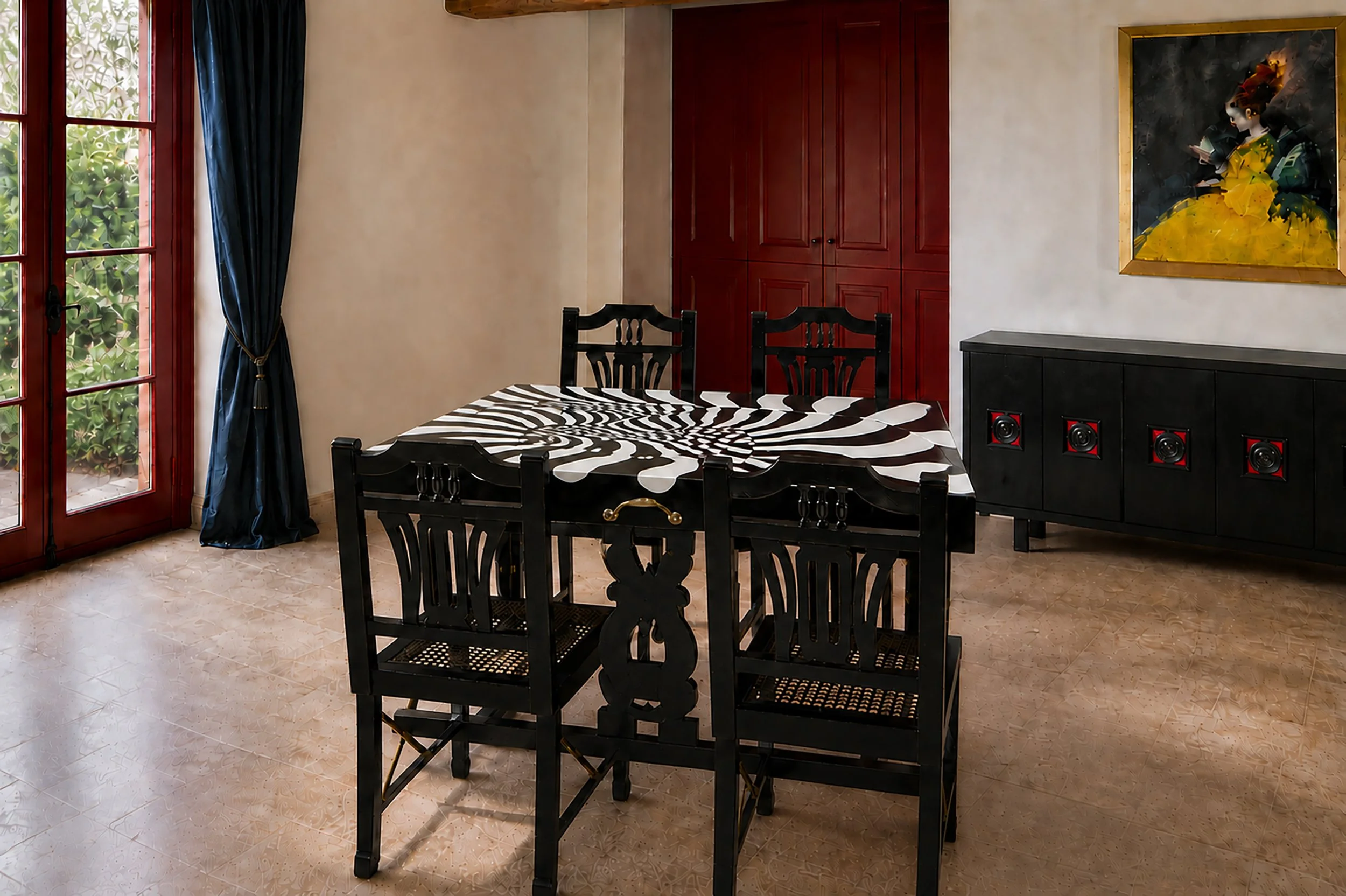 Image 2 of 9
 Image 3 of 9
 Image 4 of 9
 Image 5 of 9
 Image 6 of 9
 Image 7 of 9
 Image 8 of 9
 Image 9 of 9